
Is fiction "true"?
What fictional stories reveal about ourselves


Wonder Waves (Brigitte Kratz) and Fragments of Humanity (Rachel Parker) circle a lot of the same questions from different angles—one grounded more in philosophy and art, the other in psychology and neuroscience—but both through literature. What makes us who we are? How do we come to know ourselves? Can we change?
Recently, during a conversation with our writing community at Write Hearted, a fellow writer observed that such work helps demonstrate how “fiction is true.” The phrase stopped us both. It captured something we’d each been exploring separately, and it sparked a question we wanted to answer together: In what ways does fiction feel true? What follows is our collaborative attempt to answer that question, each from our own perspective.
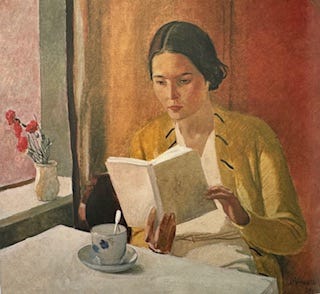
“In reality, every reader is, while he is reading, the reader of his own self.”
– Marcel Proust
Literature helps us recognize ourselves. Fictional worlds, when crafted with care and psychological honesty, become mirrors in which we discover not only the writer’s wisdom, but our own. We enter a parallel, psychological space where certain human truths can play out.
So, is fiction “true”?
After John Steinbeck died, his wife published in Journal of a Novel the many letters he wrote to his editor Pat while he was composing East of Eden in 1951. In one of them, thinking of their two sons who were four and six years old at the time, Steinbeck wrote:
“And so I will tell them one of the greatest, perhaps the greatest story of all–the story of good and evil, of strength and weakness, of love and hate, of beauty and ugliness. I shall try to demonstrate to them how these doubles are inseparable–how neither can exist without the other.”1
For Steinbeck, East of Eden was the place he carved out to be wholly honest, and the book in which he came closest to writing what he had long prayed was in him. His protagonists return many times to the Salinas Valley. Though Salinas is a real place–Steinbeck was born and raised there–he elevates it to a symbol that the reader can recognize: how good and evil grow side by side, and how each of us carries an interiority shaped by our many selves and the places we come from.
I didn’t grow up in Salinas, far from it. I grew up in Germany and (much) later remade my life in the American Midwest. And yet I recognized myself in the two figures who maybe carry Steinbeck’s lesson most clearly. Cal Trask, who is pulled between wanting to be good and believing he can’t, and Abra Bacon, who slowly grows into her agency, choosing a different life than the one first laid out for her. In them, and in Steinbeck’s sweeping story arcs, I found a new way of looking at my own contradictions. Accessing this tension in the doubleness of old and new patterns and identities, was likely also what Steinbeck wanted his sons to understand: even complicated, contradictory halves complete each other.
Facing ourselves directly, without the veil of story, is harder than we’d like to believe.
Jungian analyst James Hollis recalls teaching a course to advanced college students on the psychodynamics of love. In the first half, they discussed the theory—projection, transference, shadow. The students understood the ideas inside and out, could turn them over like familiar objects. But in the second half, Hollis asked these same students to apply the concepts to their own current relationships. In his words, “it was like the curtain came down… They could understand the ideas, but they could not bear to look at themselves with that kind of scrutiny.”2
Why is it so much easier to see the faults of others than to face our own? The resistance lives somewhere tender. We fear that if we look too closely, we might find that we are not as innocent as we’d hoped. And if we are not innocent, perhaps we are not worthy of love.
Fiction offers a side door. Jesus did not moralize the crowds who came seeking wisdom. He spoke in parables, inviting his followers to find themselves in the lives of others. Great literature works the same way, and neuroscience is beginning to illuminate why.
When we read, we don’t just process words. We build a living simulation. Neuroscientists call this a “situation model,” a mental world that tracks who is present, where they stand, what they reach for, what they want. As the story shifts, the brain updates its internal stage, lighting up regions associated with each change.
In 2009, researchers placed readers in brain scanners and watched what happened as they moved through short narratives.3 What they found was striking. Reading is deeply embodied.
When a character grasps an object, the reader’s brain activates the same motor circuits we use to grasp real objects. When a character crosses a room, regions responsible for spatial navigation flicker to life.
And perhaps most remarkably, when multiple dimensions of a story shift at once, the anterior cingulate cortex surges with activity, signaling the brain to update its simulation and brace for what comes next. In other words, reading exercises the brain’s capacity for revision—practicing, again and again, how to let go of one model of reality and build another.
This is how fiction slips past the ego’s sentries. In the safety of a story, we can rehearse being wrong. We inhabit another’s life from the inside, learning from their missteps before we’ve had time to raise our defenses.
Consider Willy Loman, the road-weary protagonist of Arthur Miller’s Death of a Salesman. Willy cannot bear the possibility that he is simply ordinary. So his life becomes an elaborate performance to shield him from the truth. Inflated stories. Impossible demands on his sons. A slow poisoning of everything he loves. In the end, even his death is a delusion.
Death of a Salesman premiered at the Morosco Theatre in New York City on February 10, 1949. As the final curtain fell, grown men in business suits sat weeping. In Willy Loman’s unraveling, they recognized something they had spent lifetimes refusing to see in themselves: the quiet terror of not being enough. Confronted directly, they would have turned away. But Willy had become a mirror they could bear to look into.
This is the power of fiction.
There is something about the distance a text can create between itself and us. When we are too close to our own lives–the many events, people, things–everything seems to dissolve into an ocean of time that overwhelms our ability to understand. There’s no distance from which to see clearly; it all feels too fluid, too immediate to transform into meaningful perspective. Yet when we swing too far in the opposite direction, we lose emotional contact and observe our lives as if they belonged to someone else. Fiction creates a sort of middle distance, a place where we can lose just enough sight of ourselves but are still tethered to something unknown and familiar.
Karl Ove Knausgaard has written about this tension often, especially in Inadvertent:
“We open ourselves to another voice, which we turn into ourself, for when we read, what we feel are our own feelings, our own fears and enthusiasms, sorrow and joy, and when we reflect the reflections are our own, performed by our own self, but only as apprehended by the other, annexed by the other.”4
Literature becomes both a hiding place and a place to become visible. Fiction can’t “save” us, but it may return us to our lives a little less defended and more capable of living out our own courageous visions. And is this not a kind of imaginative self-revision?
In a recent Paris Review interview, French writer Hélène Cixous described this paradoxical blurriness between invention and reality when she was asked how much of her fiction was autobiographical. Her response:
“When one writes, one doesn’t ask oneself, Is it fictional? Is it autobiographical? No. All writing that is strong, alive, is autobiographical. At the same time, everything is invented. Everything Proust wrote has passed through what reality whispered to him.”5
In drafting different lives, we rehearse new potential aspects of our becoming. Fiction helps to loosen our certainty and pierces through the cotton wool of our habits and blind spots. We open up more to the world, and to new stories we can tell about ourselves.
We all need unseen hands that teach us how to become authentic and capable of living. Some of these hands belong to what we read or what we see in art. Some belong to our own neurobiology, which doesn’t sharply distinguish between lived experience and imagined experience.
Either way, fiction helps us feel into our truth.
We had so much fun writing this piece together! If you enjoyed it and are new to either of our writings, please consider subscribing to Rachel Parker or Brigitte Kratz. We thank Michelle Varghese for her keen editing eye, and everyone at Write Hearted for their ongoing support.
So we return to the question: Is fiction true? We’d love to hear from you. Do you find yourself in stories, or do you read to escape yourself? Have certain characters hit home in ways you didn’t expect, and maybe revealed something you couldn’t have seen otherwise? What truths has fiction shown you?
Tell us in the comments.
Steinbeck, John. (1969). Journal of a Novel: The East of Eden Letters. New York: Viking Press, p. 4)
Hollis recounts this story during his interview with Andrew Huberman on the Huberman Lab podcast, Dr. James Hollis: How to Find Your True Purpose & Create Your Best Life (May 13, 2024), available at https://www.hubermanlab.com/episode/dr-james-hollis-how-to-find-your-true-purpose-create-your-best-life
Speer and colleagues placed 28 participants in fMRI scanners while they read four short narratives describing the everyday activities of a young boy. The researchers coded each story for six dimensions of situational change: characters, goals, objects, spatial location, causality, and time. They found that different brain regions tracked different aspects of the narrative. When characters interacted with objects, the left precentral sulcus (premotor cortex) and postcentral cortex activated—regions involved in the human grasping circuit. When characters moved through space, the parahippocampal cortex and frontal eye fields responded. When characters pursued goals, the posterior superior temporal cortex—associated with observing intentional action—increased in activity. And notably, when multiple dimensions of the story changed at once, the anterior cingulate cortex surged, appearing to signal the brain to update its mental model. The authors conclude that readers understand stories by constructing embodied simulations, recruiting the same neural systems used for perception and action in the real world. See: Speer, N. K., Reynolds, J. R., Swallow, K. M., & Zacks, J. M. (2009). Reading stories activates neural representations of visual and motor experiences. Psychological Science, 20(8), 989–999. Available at: https://pmc.ncbi.nlm.nih.gov/articles/PMC2819196/pdf/nihms-171699.pdf
Knausgaard, Karl Ove. (2020). Inadvertent: Why I Write. New Haven, CT: Yale University Press, p. 81
The Paris Review, No. 254, Winter 2025, p. 59-60
 | A guest post by
|