
The courage for joy

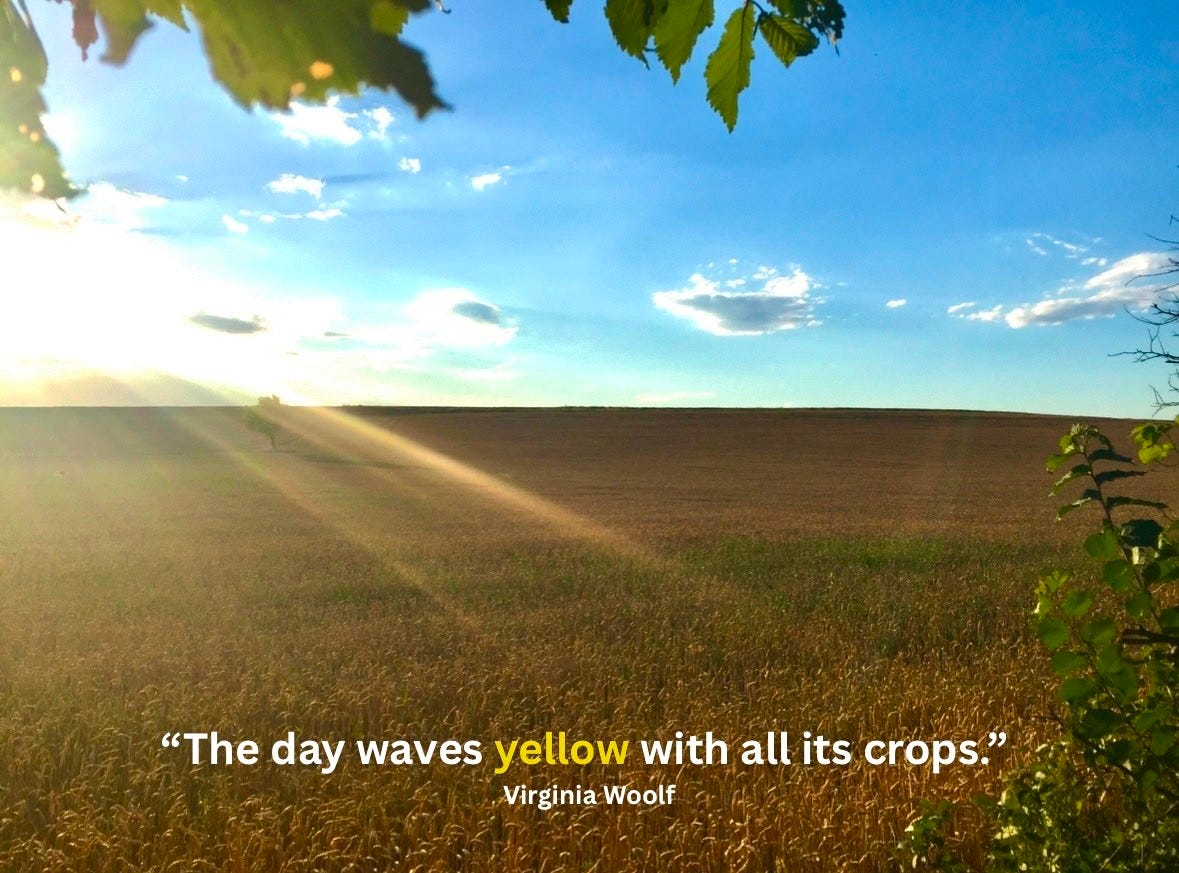
If I had to describe my favorite feeling it would be that of pure joy. Such joy feels effortless and expansive. It radiates from the heart and makes you want to burst. At least for me, joy is luminous and somehow lush with yellow, very similar to how Virginia Woolf once described it: “The day waves yellow with all its crops.”
When I write about this type of effortless joy, I’ve already learned how easily it is lost or seems out of reach. Real joy is a feeling as complete as it is complex, demanding our surrender to the moment as it is and no holding back.
Real joy is hard.
As I do with many of my questions, I asked my books: What is joy, and why is it so elusive?
In the following, I created an imaginary dialogue between four authors whose writings have helped me to synthesize insights around joy and my own experience. While this is completely fictional, the dialogue builds around actual or paraphrased ideas from these thinkers. This creative form of writing felt surprisingly meaningful to me and helped me to reorient myself on my path of leaning into joy. It is the updated version of an essay I published in 2024.
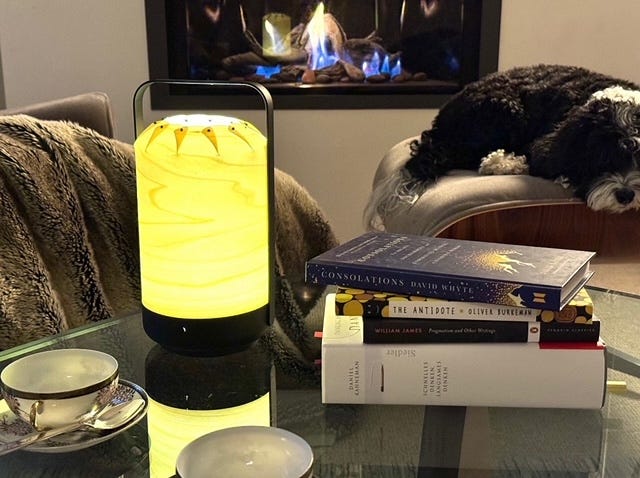
I am settling into my living room chair, the fire’s warmth wrapped around me. The room takes on a dreamlike possibility. Green ginger tea is steaming. I glance around my book-walled space and blink—there they are! Four thinkers (seem to be) sitting nearby, their expressions thoughtful and curious, their poses relaxed. After some joyful banter, they turn to me, smiling and nodding encouragingly. May I present:
Oliver Burkeman: Journalist and author; his books The Antidote and Four Thousand Weeks (and other works) have influenced how I think about joy and time
Daniel Kahneman (1934-2024): Psychologist, Nobel Laureate in Economic Sciences; author of Thinking, Fast and Slow and other works
David Whyte: Poet and philosopher; I love how his Consolations and Consolations II (and other works) explore the underlying meaning of everyday words
William James (1842-1910): Philosopher and psychologist who is considered as the “father of American psychology”; author of Pragmatism and other works
Me: I thank you all for coming. Shall we begin?
James: Yes, to start please tell me: how would you describe the texture of joy?
Me: Joy doesn’t feel the same every time. Often, it is like liquid light that warms me from the inside. There’s a fullness to joy when I connect with my own nature, or when I’m with people who I share a familiarity or even a bunch of history with. At other times, my joy is sharper and more crystalline. A sudden, piercing awareness of beauty, like the quick glint of sunlight that shimmers through the leaves as I walk my dog in early summer. A texture of light that suddenly catches my breath.
Joy likes to come in flashes. For example in moments when I laugh so hard my stomach hurts or when I dance with friends to an age-old Bowie song we grew up with. It’s the warmth of skin against skin or when I gallop on our horse Chip. But then there’s also the expansive brightness of joy on days I can spend in closeness with my daughter or in silence with my books.
But such luminous moments eventually fade, often as quickly as they came. Like light turning to shade. Why is that?
Burkeman: Yes, isn’t it strange how joy, something so light and freeing, can carry its own surprising weight? There is this vulnerability to joy, a bright delicateness, and some part of us knows how easily it can disappear. I’m thinking of this story you shared with me. In 2010, you flew from Minneapolis to meet your father and sister in New York, incidentally on the very day the Eyjafjallajökull volcano erupted in Iceland which grounded intercontinental flights for a week. They arrived on the last flight that made it across the Atlantic that day. The cherry trees across the city were at the height of their fleeting bloom. The three of you wandered the city streets until you came upon a restaurant with a tucked-away garden, a place that felt fallen out of time for a few magical hours. Petals of the rosy cherry blossoms were softly landing on you–
Me: I will never forget that afternoon…
Burkeman: I can believe it. In The Antidote, I write about the paradox of happiness. Joy asks us to open ourselves, to be willing to feel deeply. But in doing so, we expose ourselves to the fear of loss. Fully allowing joy means acknowledging its impermanence. That it can be gone in the next breath, terrifyingly. I write:
It’s our constant effort to eliminate uncertainty and manage our emotions that makes us feel less secure, not more. In the attempt to protect ourselves from life’s inevitable sorrows, we end up missing out on its moments of happiness.
Me: I remember times in my life when I felt guarded as if I was holding myself back. During and after a painful separation, for example, I felt like a part of me was sealed off, as if I had trained my heart to remain closed and guarded, while hoping to be safe. Living fully and joyfully felt like…risking too much.
Burkeman: Joy requires courage. It asks from us to open ourselves, and that openness makes us feel exposed. Hannah Arendt once said that the trouble with human happiness is that it is constantly beset by fear. Real joy doesn’t offer guarantees. Change and loss are inevitable parts of life. It sounds cliché and yet remains forever true: All we can ever have is the fullness and beauty of the present moment. And that’s maybe also how I’d define joy: our love for the moment.
In our human craving for predictability, we want to control and hold on to joy. Only that it doesn’t work that way. In the same way that we can’t collect and treasure sunlight in a jar…
Whyte: That’s where the challenge lies, quite exactly. Joy asks us to live with an open heart and an open hand, letting it come and go as it pleases. Living fully means a continual surrender, a kind of courageous openness. I write in Consolations:
To feel full joy is to have become generous; to allow ourselves to be joyful is to have walked through the doorway of fear.
Joy is a delicate balance, a giving and taking with the world around us. When I am in “the presence of a mountain, a beautiful sky, or a well-loved familiar face,” it’s in the joy of privilege and glorious experience that we say:
I was here, and you were here, and together we made the world.
Me: How beautiful. Joy makes me vulnerable but also strong and makes me feel closer to what is my more steady core of nature. There was a part of me that longed to shed the roles and self-limiting beliefs that served as my protective layers for so long. They have shielded me, yes, but also kept me from fully maturing and knowing myself.
A number of my beliefs used to be quite rigid. I had to learn how to create some distance and a more mature consciousness to start to look at a belief as just one of many possible perspectives. I often observed my world through the self-chosen lens of being ‘lesser than’ or ‘not perfect enough. Criticism would hurt me, sometimes even eat me up. I placed way more weight on negative experiences or emotions than positive ones. A rather narrow and self-constraining story, and an active way of locking myself out of my own talents, and the soft and intuitive resilience that can come out of sensitivity.
Kahneman: May I add to this exchange. This is a very human tendency. Our minds are wired with a natural bias toward the negative. I wrote about this in Thinking Fast and Slow. I distinguished between the ‘remembering self’ and the ‘experiencing self.’ The remembering self may like to hold onto memories around suffering and struggle, as if choosing pain over joy. A survival instinct after all. Our minds evolved to memorize threats in order to keep us safe.
Me: So I was holding onto negative memories as a safety net? A shield against being caught off guard? A biased and habituated stance of self-protection, mistaken for truth and realism.
Kahneman: Exactly. And your experiencing self—the part of you that lives moment to moment—had a hard time being naturally open to joy, because your remembering self kept hovering, kept nudging you to stay cautious.
Burkeman: It’s so easy to complicate things by overthinking happiness. We set these rigid expectations about what joy should look like, and when reality falls short, we panic, blame others or shut down in order to shield ourselves. But joy needs space to naturally expand instead of a controlling expectation of perfection. Where we let go and allow ourselves to simply be.
Me: Your writing felt liberating to me in the way it helped me to look at some things differently. It allowed myself the room for my joy and aliveness to develop more naturally. To trust that relinquishing control was okay and all I ever could do anyway.
Burkeman: Precisely. Joy is much about showing up to the flow of life with a flexible mindset. Life is inadvertently ambiguous and has ups and downs. Life refuses to fit neatly into our stories.
James: We can all be captives of our own limiting stories. I had a crisis of despair around the age of twenty-eight. I was convinced that my lack of direction revealed some deep flaw in me, a proof that I would never amount to anything. My family was full of intellectual brilliance and accomplishment; by comparison, I felt trapped in my mind, the path before me shapeless. I was paralyzed by the belief that my character was fixed and all I would or could ever be.
I only later began to realize that I could actually rethink my beliefs. I embraced pragmatism because I realized life never could and never would unfold in predictable ways. Freedom comes when we realize that we can step outside of our stories. Even the ones that feel carved into us.
Me: I never knew how much you struggled as a young man until I recently read about this. And yet you became the revered father of American Psychology by offering one of the first comprehensive maps of the human mind. You explored how what we attend to becomes our life. So why do we cling to familiar, safe stories even if they limit us?
James: We hold onto our notions of past and future as if they were solid truths, instead of leftover fragments – or replantable seeds for new growth – of our imagination. From a pragmatic point of view, let me say this plainly: almost nothing people say is true or truly fixed.
Me: Wow, let me say that again: almost nothing people say is true. That’s huge. Not even our own beliefs about ourselves. Not even…the world around us. I wrote down these quotes from your famous Harvard Lectures:
The world is one if you look at it one way, but many if you look at it another.
The world is what you make of it.
Whyte: Bravo. You know, the real courage for joy is to surrender to it and let it change us. When we face our own inner resistance, we come face-to-face with the parts of ourselves that we have hidden. We dare to look at our shadows that we’ve tried so hard to keep at bay.
Me: I see what you mean. Instead of avoiding, narrating, prodding, I can let go and pay more attention to just what is in the moment. I let the moment break my heart open, without defenses.
Our small improbable group in my living room falls silent. Without defenses; without defenses, our internal voices recant. I get up and find my phone in the kitchen, pick it up and load a three-minute clip I had recently come across and loved. It shows the electrifying musician Jacob Collier in action and how he weaves a room full of musicians and listeners into communal joy and harmony. I feel compelled to show it to my four visitors in my living room. When I start the video, James Williams looks the most astonished:
Burkeman: Incredible. This is so moving. You know, in a way joy is practical. In this moment of watching this together, we are present and feeling the music and what it moves in us and in relation to other people around us. This is the courage and surrender to joy “in action”. Each time we have the courage to embrace the moment fully, our heart grows a little. It grows in clarity, authenticity, and hopefully in viscerally felt aliveness.
Me: I feel delighted. Thank you all so much. Who would like more tea?
The conversation with luminaries were all a perfect set up for the masterfully inserted punch of the Jacob Collier video. I was eating lunch while reading, and then watching the video, and what's really hard is crying and eating lunch at the same time. You should know that your whole creative expression here with its ingenuity and parts left me riding a true wave of the very feeling in question. Joy. Joy through the words, the music, my lunch, and the hot and salty tears.
I like your version of Kahneman better than the real thing 😀